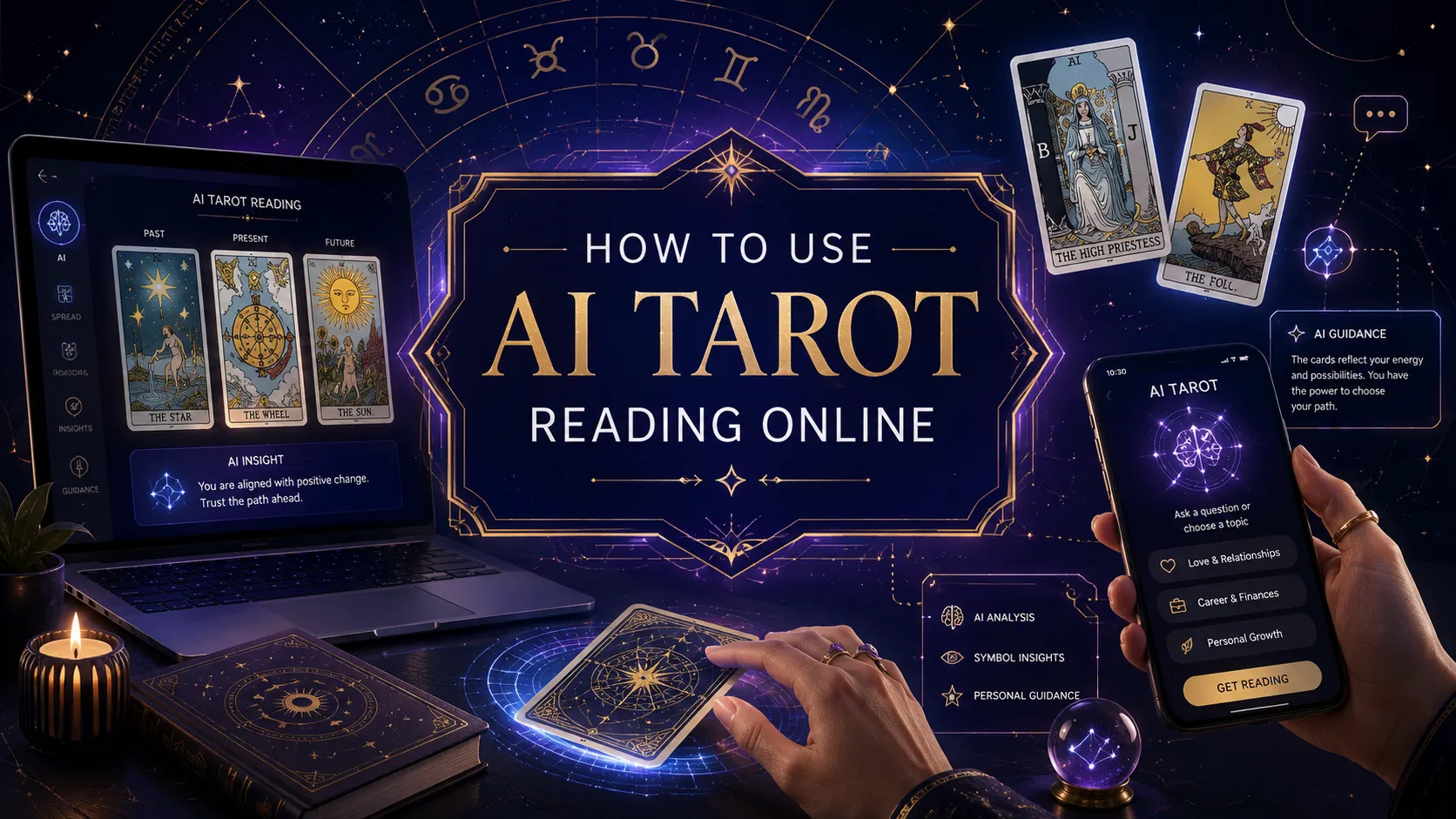
Learning how to use AI tarot reading online is mostly about three skills: asking a clear question, choosing the right spread, and reading the result as guidance rather than a fixed prediction. AI tarot tools can draw digital cards, explain card meanings, and connect the reading to your situation in seconds.
The quality of the answer depends heavily on how you use the tool.
To use AI tarot reading online, choose a reliable tool, set a clear intention, ask an open-ended question, select a spread, read each card in its position, and turn the result into practical reflection. Start with one-card or three-card spreads before trying complex layouts such as the Celtic Cross.
What Is an AI Tarot Reading?
An AI tarot reading is an online tarot experience where artificial intelligence helps generate the interpretation. The tool may let you draw cards from a digital deck, choose a spread, enter a personal question, or describe a physical tarot spread.
Most AI tarot readers combine:
- traditional tarot card meanings
- spread positions
- the user’s question
- a generated explanation
For example, The Tower in a challenge position may be interpreted differently from The Tower in an advice position.
Step 1: Choose a Reliable AI Tarot Tool
Start with a tool that clearly shows how the reading works. A good platform should let you:
- ask a custom question
- choose a spread
- see which cards were drawn
- read each card in context
- understand whether the reading is for reflection or entertainment
- avoid unnecessary personal data collection
Some tools offer free one-card readings. Others provide deeper spreads after sign-up or payment. For a beginner, start simple. You do not need a complex Celtic Cross reading for your first session.
Step 2: Set a Clear Intention
AI tarot works better when you know what you want from the session.
Ask yourself:
- What am I trying to understand?
- Is this about love, career, timing, confidence, or a decision?
- Do I want reflection, advice, or emotional clarity?
- Am I asking for insight, or am I looking for permission?
Weak intention:
Tell me everything about my life.
Better intention:
I want to understand what I should consider before accepting a new job offer.
Step 3: Ask a Better AI Tarot Question
The question is the most important part of an AI tarot reading. Vague questions produce vague answers. Focused questions create more specific guidance.
Instead of:
Will my ex come back?
Try:
What should I understand about my attachment to this relationship?
Instead of:
Will I get rich?
Try:
What habit or decision may influence my financial stability this year?
Instead of:
Should I quit my job?
Try:
What should I consider before deciding whether to leave my current job?
Best AI Tarot Question Formats
Use what and how questions:
- What energy surrounds this situation?
- How can I approach this decision with more clarity?
- What should I focus on this week?
- How can I communicate better in this relationship?
- What am I not seeing clearly?
Avoid questions that remove your agency:
- Will I definitely marry this person?
- Is my coworker secretly against me?
- Should I invest all my savings?
- When exactly will I become successful?
More useful alternatives:
- What pattern should I notice in this connection?
- How can I protect my energy at work?
- What should I research before making this financial decision?
- What strength can I build during this stage of my career?
Step 4: Choose the Right Tarot Spread
A tarot spread is the layout of cards. Each card position has a role.
One-Card Spread
Best for quick guidance.
Use it for:
- daily reflection
- emotional check-ins
- one focus point
- low-stakes questions
Three-Card Spread
Best for beginners.
Common formats include:
- past, present, future
- situation, challenge, advice
- mind, body, spirit
- option A, option B, guidance
- what I know, what I do not know, next step
Example prompt:
Use a three-card spread: situation, challenge, and advice. My question is: How should I approach my next career move?
Yes-or-No Spread
Best for a quick signal, not a major decision.
Use a safer prompt:
Give me a yes-or-no tarot reading, but explain the conditions, risks, and what I should consider before acting.
Avoid yes-or-no readings for medical, legal, financial, or safety decisions.
Love Tarot Spread
Best for relationship reflection. A love reading can also pair well with an AI relationship coach when the goal is communication rather than prediction.
Better question:
What should I understand about my role in this relationship dynamic, and what would support healthier communication?
Career Tarot Spread
Best for work decisions.
Good questions include:
- What should I focus on professionally this month?
- What is blocking my confidence at work?
- What should I consider before changing jobs?
- How can I prepare for a leadership opportunity?
Celtic Cross
Best for complex situations.
The Celtic Cross can explore the present issue, challenge, past influence, future direction, hidden factors, advice, hopes and fears, and possible outcome. Beginners should usually start with a one-card or three-card spread.
Step 5: Interpret the AI Tarot Result
Read actively after the AI gives you a result.
Start With Card Positions
Ask:
- Is this card describing the situation, challenge, or advice?
- How does the position affect the meaning?
- How does it answer my original question?
Look for Patterns Across Cards
Do not interpret each card in isolation. Notice repeated themes, emotional tone, action words, and tension between cards.
If several cards point toward rest and reflection, the message may be about patience rather than immediate action.
Separate Symbolism From Decision-Making
If the reading says “a new opportunity is opening,” ask:
- What real opportunities exist right now?
- What action can I take?
- What information do I still need?
- What would a practical next step look like?
Step 6: Save and Review Useful Readings
If you use tarot for self-reflection, save your readings. iWeaver can help collect AI tarot outputs with an AI notes generator, tag them by theme, summarize recurring patterns, and connect them with journal notes or decision records.
You can also compare tarot readings with broader symbolic tools such as an AI fortune teller when you want a wider reflection format.
Example AI Tarot Prompt
Use this beginner-friendly prompt:
Give me an AI tarot reading using a three-card spread: situation, challenge, and advice. My question is: I am deciding whether to stay in my current job or look for a new role. I want grounded reflection, not a prediction. Please explain each card in context and end with three practical takeaways.
This works because it gives the spread, explains the situation, sets a boundary around prediction, and asks for useful takeaways.
Common Mistakes to Avoid
Avoid these habits:
- asking the same question repeatedly until you get the answer you want
- treating AI tarot as certainty
- asking about another person’s private thoughts
- making major decisions from one reading
- ignoring your own judgment
- oversharing private information
- using fear-based readings as evidence
If a reading feels manipulative or frightening, step away.
How do I use AI tarot reading online?
Choose a reliable tool, ask a clear question, select a spread, read each card in context, and use the result as reflection rather than certainty.
What is the best AI tarot spread for beginners?
A one-card spread is best for quick daily guidance. A three-card situation, challenge, and advice spread is best for deeper beginner readings.
What questions should I ask AI tarot?
Ask open-ended questions such as “What should I understand about this situation?” or “How can I approach this decision with more clarity?”
Are AI tarot readings accurate?
They can be useful for reflection, but they are not guaranteed predictions. Use them as symbolic guidance and keep your own judgment.
Can iWeaver save AI tarot readings?
Yes. iWeaver can organize AI tarot readings, notes, recurring cards, and decision reflections so you can review patterns over time.