
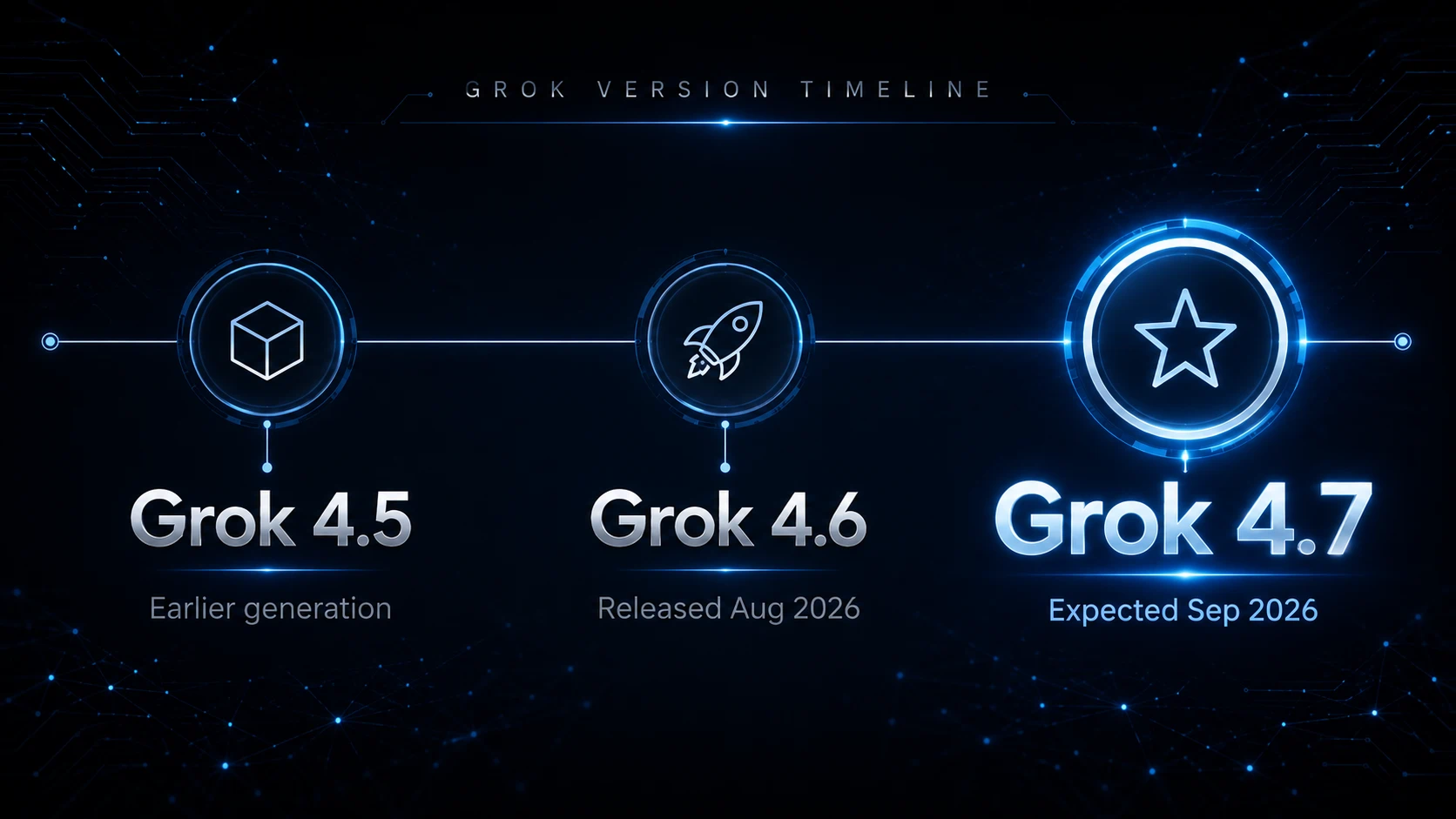
Grok 4.7 is officially here. Released on September 21, 2026, Grok 4.7 is xAI's latest frontier model for coding, agentic tasks, and professional knowledge work.
This is more than a small update to Grok 4.6. xAI says Grok 4.7 uses a new, larger base model, a longer reinforcement learning run, and training that puts more weight on difficult tasks that can take hours to complete. It also improves self-verification and long-context management—two areas that matter much more in real workflows than simply answering short prompts. And unlike the early speculation around Grok 4.7, we now have official specifications and benchmark results to compare.
Grok 4.7 Release Date
Grok 4.7 officially launched. It is available through the xAI API as: grok-4.7
At launch, xAI also made the model available through several coding and AI platforms, including Grok Build and Cursor. GitHub has also started rolling Grok 4.7 out to GitHub Copilot users.
For more background on the previous generation, you can also check our Grok 4.6 review.
Grok 4.7 Specs at a Glance
Here are the main official specifications.
| Specification | Grok 4.7 |
|---|---|
| Release date | September 21, 2026 |
| Model name | grok-4.7 |
| Context window | 500,000 tokens |
| Knowledge cutoff | May 2026 |
| Input modalities | Text and image |
| Output modality | Text |
| Text output limit | No fixed text output limit |
| Reasoning levels | Low, Medium, High, XHigh |
| Default reasoning | High |
| Function calling | Supported |
| Web search | Supported |
| X search | Supported |
| Code execution | Supported |
| API support | Responses API, Chat Completions |
The 500K context window is particularly useful for long documents, large codebases, multi-file projects, research tasks, and agent workflows that need to maintain a lot of information over time.
Grok 4.7 also supports four reasoning levels:
- Low
- Medium
- High
- XHigh
This lets developers trade off speed and reasoning depth depending on the task.
What's New in Grok 4.7?
The most important changes are not flashy new interface features.
They are improvements to how the model handles longer and more difficult work.
1. A New, Larger Base Model
Grok 4.7 is built on a new and larger base model compared with Grok 4.6.
That matters because this is not simply Grok 4.6 with additional post-training.
The underlying model itself has changed.
xAI then trained it with a longer reinforcement learning run on a harder mixture of tasks, with more emphasis on problems that may take many hours to complete.
The goal is clear:
make Grok better at finishing difficult work, not just starting it well.
2. Better Long-Task Performance
Many AI models look impressive on short prompts but become less reliable as a task gets longer.
That can show up as:
- forgotten instructions
- inconsistent decisions
- repeated work
- missed dependencies
- errors that are never checked
- poor use of earlier context
Grok 4.7 is specifically trained to perform better on longer-running tasks.
This is especially relevant for coding agents, research workflows, document creation, and professional work involving multiple stages.
3. Better Self-Verification
Another important change is stronger self-checking.
Instead of simply generating an answer and moving on, Grok 4.7 is designed to verify its own work more carefully.
That matters in tasks such as:
- debugging code
- editing large projects
- checking calculations
- reviewing documents
- following long instructions
- using multiple tools in sequence
Of course, self-verification does not mean the model cannot make mistakes.
Human review is still important for high-stakes work.
But better internal checking can reduce obvious failures during long workflows.
4. Stronger Agent and Knowledge Work
Grok 4.7 was also trained to better understand xAI's Grok Bot harness.
That makes the model especially relevant for agent-style tasks where the AI needs to do more than answer a single question.
For example:
- inspect files
- search for information
- write code
- run tools
- review results
- revise its own work
- continue until a larger task is complete
This reflects a broader shift in frontier AI.
The key question is no longer just:
Can the model answer this question?
It is increasingly:
Can the model complete the entire task?
Grok 4.7 Benchmarks
xAI published benchmark results comparing Grok 4.7 with Grok 4.6 and other frontier models.
The results show especially noticeable gains in coding, terminal-based tasks, engineering, and professional knowledge work.
For the cleanest comparison, the table below focuses on Grok 4.7 vs Grok 4.6.
| Benchmark | Grok 4.7 | Grok 4.6 | Change |
|---|---|---|---|
| CursorBench 4.0 | 46.3% | 40.4% | +5.9 pts |
| DeepSWE v1.1 | 71.0% | 65.2% | +5.8 pts |
| AA Briefcase v1.1 | 1,657 | 1,546 | +111 |
| Terminal-Bench 4.0 | 38.0% | 20.3% | +17.7 pts |
| Harvey Legal Agent Benchmark | 19.6% | 15.8% | +3.8 pts |
| HealthBench Professional | 56.7% | 48.5% | +8.2 pts |
| EEBench | 64.0% | 53.0% | +11.0 pts |
The largest jump in this set appears on Terminal-Bench 4.0, where Grok 4.7 scores 38.0% compared with 20.3% for Grok 4.6.
That is particularly relevant for agentic coding workflows involving terminal commands, tools, repositories, and multi-step execution.
Grok 4.7 also shows noticeable gains in electrical engineering, professional knowledge work, software engineering, and clinical reasoning benchmarks.
Grok 4.7 vs Grok 4.6
The benchmark numbers make the generational change easier to see.
| Grok 4.6 | Grok 4.7 | |
|---|---|---|
| Status | Previous generation | Latest generation |
| Base model | Earlier model | New, larger base model |
| Context window | — | 500K tokens |
| Long-running tasks | Strong | Improved |
| Self-verification | Strong | Improved |
| CursorBench 4.0 | 40.4% | 46.3% |
| DeepSWE v1.1 | 65.2% | 71.0% |
| Terminal-Bench 4.0 | 20.3% | 38.0% |
| EEBench | 53.0% | 64.0% |
| API input price | $2 / 1M tokens | Starts at $2 / 1M tokens |
| API output price | $6 / 1M tokens | Starts at $6 / 1M tokens |
The biggest reason to move from Grok 4.6 to Grok 4.7 is therefore not a single headline feature.
It is the combination of:
better coding + stronger long-task performance + better context management + stronger self-checking.
If your workload mainly consists of short everyday questions, the difference may feel smaller.
For developers and users running long, multi-step workflows, the improvement is more meaningful.
Grok 4.7 Pricing
Grok 4.7 starts at:
- $2 per 1 million input tokens
- $0.50 per 1 million cached input tokens
- $6 per 1 million output tokens
These rates apply when the prompt is below 200K tokens.
For prompts above 200K tokens, the official API pricing increases to:
- $4 per 1 million input tokens
- $1 per 1 million cached input tokens
- $12 per 1 million output tokens
This tiered pricing is worth noting because Grok 4.7 has a 500K context window.
Using the full context window can therefore cost more than shorter requests.
What Is Grok 4.7 Fast?
xAI also offers Grok 4.7 Fast.
This is the same underlying model served on faster infrastructure.
According to xAI, it delivers around twice the output speed at twice the standard token rates.
However, there is an important availability difference:
Grok 4.7 Fast is currently available through Cursor and Grok Build, but not through the public xAI API.
That makes the standard Grok 4.7 model the main option for developers building directly with the xAI API.
Where Can You Use Grok 4.7?
Grok 4.7 is already available across several platforms.
xAI API
Developers can use:
grok-4.7
through the xAI Responses API or Chat Completions API.
It supports tools including:
- function calling
- web search
- X search
- code execution
Grok Build
Grok 4.7 is the default model for Grok Build, xAI's coding and app-building agent.
Cursor
Grok 4.7 is available in Cursor.
The Fast variant is also available there.
Model Gateways
xAI documentation lists availability through platforms including:
- OpenRouter
- Vercel
- Cloudflare
GitHub Copilot
GitHub began rolling out Grok 4.7 to GitHub Copilot on September 21.
It is being made available across Copilot Pro, Pro+, Max, Business, and Enterprise plans.
Supported environments include:
- Visual Studio Code
- Visual Studio
- Copilot CLI
- GitHub Copilot cloud agent
- GitHub Copilot app
- JetBrains
- Xcode
- Eclipse
The rollout is gradual, so some users may not see it immediately.
Don't Judge Grok 4.7 by One Benchmark
The official results are useful, but a benchmark table should not be the final reason to choose a model.
Different benchmarks test different things.
A model that performs well on a coding benchmark may not necessarily be the best choice for:
- research
- document analysis
- writing
- customer support
- data extraction
- summarization
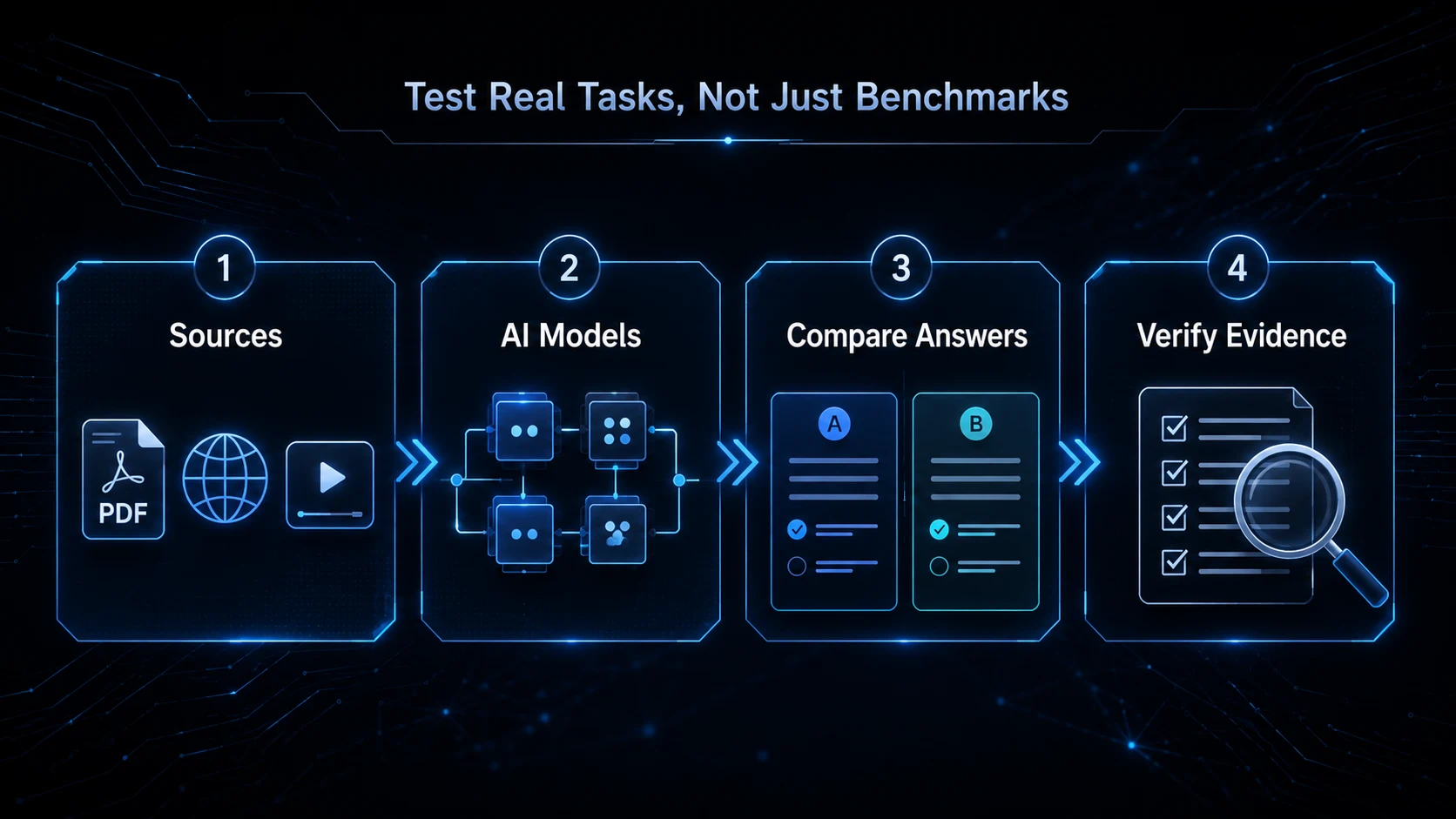
A better test is to compare models using the same real task.
For example:
- Give each model the same question.
- Provide the same source files.
- Use the same instructions.
- Compare the final answers.
- Check missing information and factual errors.
- Verify important conclusions against the original sources.
If your work involves PDFs, websites, videos, presentations, or research documents, tools like iWeaver can help organize those materials in one place before you compare model outputs.
This makes it easier to judge whether an AI model is actually useful for your workflow rather than simply better on a leaderboard.
Is Grok 4.7 Worth Using?
For coding and agentic workflows, Grok 4.7 is a meaningful update over Grok 4.6.
The official benchmark data shows improvements across software engineering, terminal work, professional tasks, electrical engineering, legal tasks, and clinical reasoning.
The combination of a 500K context window, stronger long-task performance, improved self-verification, tool support, and unchanged starting API pricing also makes the model more practical for larger workflows.
That does not mean Grok 4.7 will be the best model for every task.
Different models still have different strengths, and benchmark results do not always translate directly into better real-world output.
But Grok 4.7 gives developers and professional users a stronger option than Grok 4.6—especially when a task involves many steps, large amounts of context, or extended tool use.
Grok 4.7 is not just another small Grok update.
It uses a new, larger base model and puts much more emphasis on long-running coding, agentic work, self-verification, and professional knowledge tasks.
Compared with Grok 4.6, the official numbers show clear improvements across several demanding benchmarks, while the starting API price remains unchanged.
The more interesting question now is not whether Grok 4.7 performs better than Grok 4.6 on paper.
It is how much of that improvement carries over into real projects.
For developers, researchers, and users building longer AI workflows, that is where Grok 4.7 will ultimately be tested.